Wednesday, December 29, 2010

Hot Chocolate Instead Of Cocoa

AS A TROLLING

video as promised pescar bonitos a currican.


Evidentemente es todo de producción propia. Un intento de realizar mi primer documental. para estar realizado con teléfonos moviles y cámaras caseras no esta del todo mal. El programita Imovie facilita mucho lo de los trailers y quedan muy bien pero a la hora de hacer el video en si es como cualquier otro. espero que os haya gustado y que se entendida bien la técnica.

Thursday, December 23, 2010

Buy Chipmunks Animals In Ireland

Trailer "A NICE FISHING TROLLING"

Os  presento el trailer de mi proximo video, un breve documental para debutantes de como se pesca el bonito a currican.


This trailer is mounted with the new version of imovie and it's fun to work that easy, seems to lie the results obtained. I hope to learn to edit, how are you demos, will be a luxury.

Thursday, August 19, 2010

How To Migrate To Soul Silver


While saying that war is horrible and that any pest or slag is preferable to it, I say that the mere image of a Winged Hussar charging is one of the few exceptions that may cause war is very beautiful. Please believe me, see it yourself in one of the magnificent works of Mariusz Kozik:


The Winged Hussars of Poland are without a doubt my favorite military units. Their clothing is simply a work of art that becomes irresistible when mixed with the magnificence of a battle. And that is the story of the Winged Hussars is a story full of great battles, victories and charges heroic epic. Sounds like science fiction story, but in reality Husari, as they are known, always fought to the moment of truth.

By definition, a Hussar is a light cavalry unit that originated in Hungary around the fifteenth century AD Many authors believe that the Hussars originated from Serb warrior bands that crossed into Hungary after Turkish invasion on Serbia. However, by mid-sixteenth century in Poland, the Hussars were transformed into heavy cavalry and became the elite of the entire Polish-Lithuanian army as well as Europe. The Winged Hussars

were heavily armed. Its armament consisted of a spear called kopia , which was hollow to reduce weight and be more manageable. It was made of wood, wrought iron tip and had a length of between 4.5 and 6.15 meters long. Beneath her left leg, the Winged Hussars wore a sword thrust called koncerz , this sword was about 1.6 meters long and was used as a spear to penetrate the armor, not to cut, in fact, even had the edge on the sheet, only a very sharp tip to serve your purpose. On the left side carried their famous swords, known as szabla husarska , who were their weapons of combat. Like many elite units in history, as the Companions of Alexander, the Winged Hussars arrived to use their weapons of choice by individuals, as well as axes, hammers and various types of decks. Added to their weapons, Husari also carried one or two guns or rifles that fired a short distance before loading with the aim of disrupting the enemy front lines and more devastating charge.

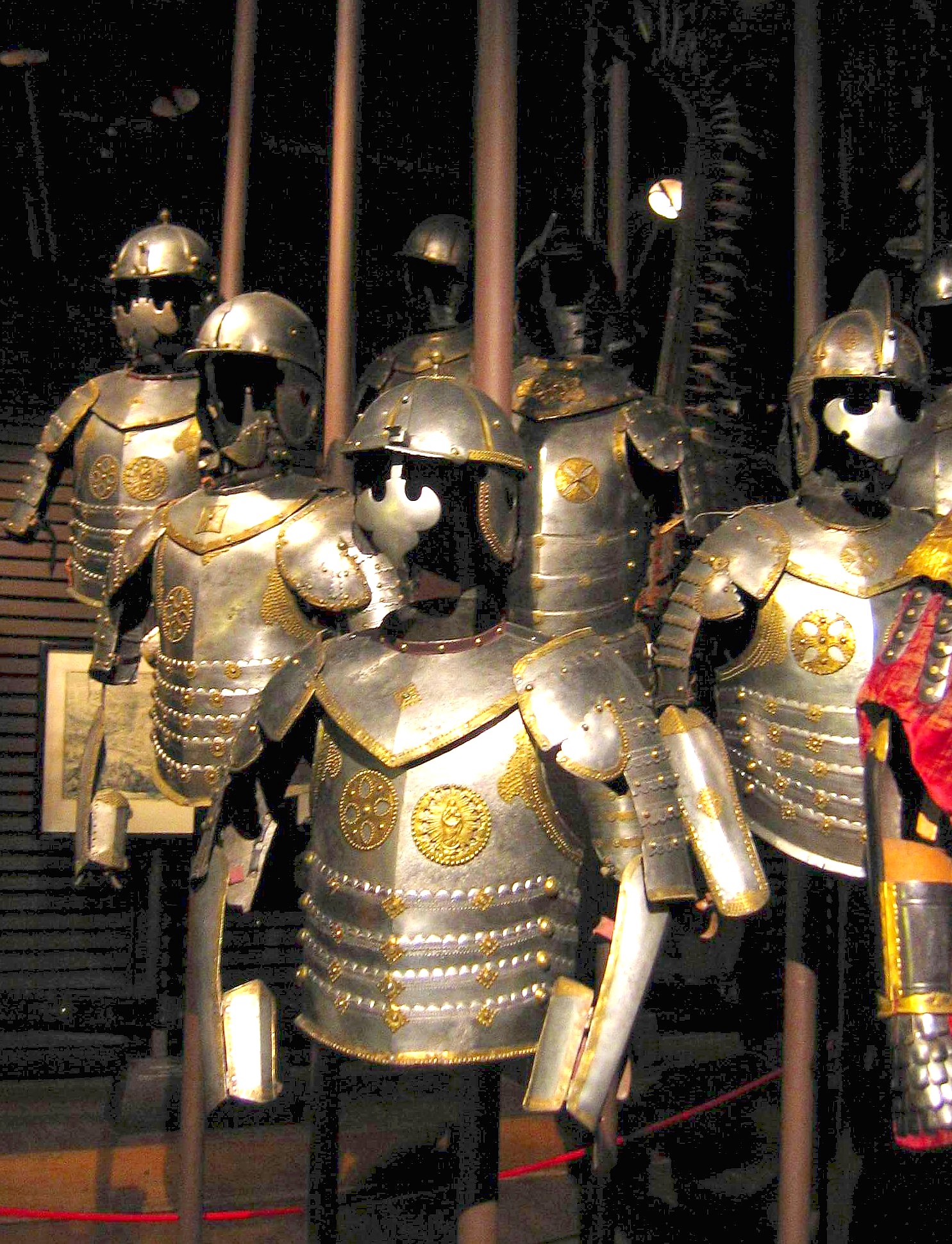
His armor consisted of a home town called szyszak Turco, who had a mask over the nose and mouth in the form of sheet. This gave the Hussars an even more daunting, because all you could see were his eyes fixed on the selected target. As head protection, had a metal shell to protect it's chest and neck, likewise, had shoulder pads and protection for at-arms. Used armor for the knees, and placed under her thighs padded coats of mail to give them comfort. Despite being highly protected, armor was fairly light, as a whole, full armor weighed around 15 kg., which allowed the riders reach speeds high enough and make more effective the load. As an exotic touch, the Winged Hussars used to wear a leopard skin attached to the body over his left shoulder as a layer. The objective of this piece was to terrorize and confuse enemy horses, because they are afraid of those wild animals which are not used and capture the presence of leopard skin because its smell is almost as good as dogs.


Finally, we have the jewel in the crown: the wings. The Winged Hussars were so named because of the practice of using a pair of magnificent wings that gave them a terrifying, not only made them appear much larger than they actually were, but it also gave them the appearance of fierce birds and eagles behind prey. Initially, the wings were placed on the sides of the riders but later were moved to their backs. The wings were made over a wooden frame and the feathers were commonly eagle or ostrich.


The purpose and use of the wings has been extensively studied and is not yet clear, however, there are many theories about them. The first and oldest suggest a package that the wings were attached to counter the Tatar ties pitchers who would not easily tie a Winged Hussar. Another common theory suggests that the wings were attached as when riding at high speeds, they produce a sound very thin and sharp that horses terrorized the enemies, who were not accustomed or trained to deal with it. In back, has also been suggested that the wings were attached to deafen themselves Polish horses in order to nullify the sounds they made with wooden instruments the Ottomans and Tatars.

However, some of these theories were apparently discarded in the 1970 during the filming of the movie "The Deluge" where several scenes that included charges of Winged Hussars found that the wings, while riding at high speeds, unbalanced rider to the point of almost throwing the saddle, likewise, when the wings were placed on the sides of the rider, slow considerably when it was galloping at high speeds. It is for these practices suggests that the wings were only used during ceremonies, parades and formal events and never for battle.

This conclusion is a bit difficult to digest because it sounds illogical that Winged Hussars have received that name and reputation just to go in his magnificent armor during ceremonies and important events. In addition, the vast majority of works of art, both literary and painting and music may represent the Husari holding their wings in battle. I doubt that all artists have agreed to over the centuries to represent wings if they were not really used in battle.


As battle tactics, the Winged Hussars came forward nearly two centuries to the world. The tactics used can be translated as "cross attack." The great Russian general Aleksandr V. Suvorov developed this tactic to his army and who is usually given credit for it, but as I mentioned before, the Polish and used 200 years earlier.

The "transversal attack" was developed as a result of necessity. During the time of boobies and gunpowder, the cavalry used to use the tactic known as "Caracollo" which was to ride toward the enemy, entering range shot, download guns or rifles and retire to reload. However, with the development of education and training combined with boobies Musketeers, "Caracollo" became useless as boobies while protecting the musketeers of the charges, they fired their rifles and decimated cavalry companies.

In response to this, the resourceful Poles developed the "transversal attack" which was to charge straight at full speed through the formations of musketeers and pikemen. To achieve this without being killed by the booby, the Winged Hussars were armed with long kopia , that throws that allowed them to hit the booby before he reached the rider or his horse. As a result of impact, the boobies were often thrown into the air on the rear of the training ranges, which increased the panic disorder and the load was more devastating.


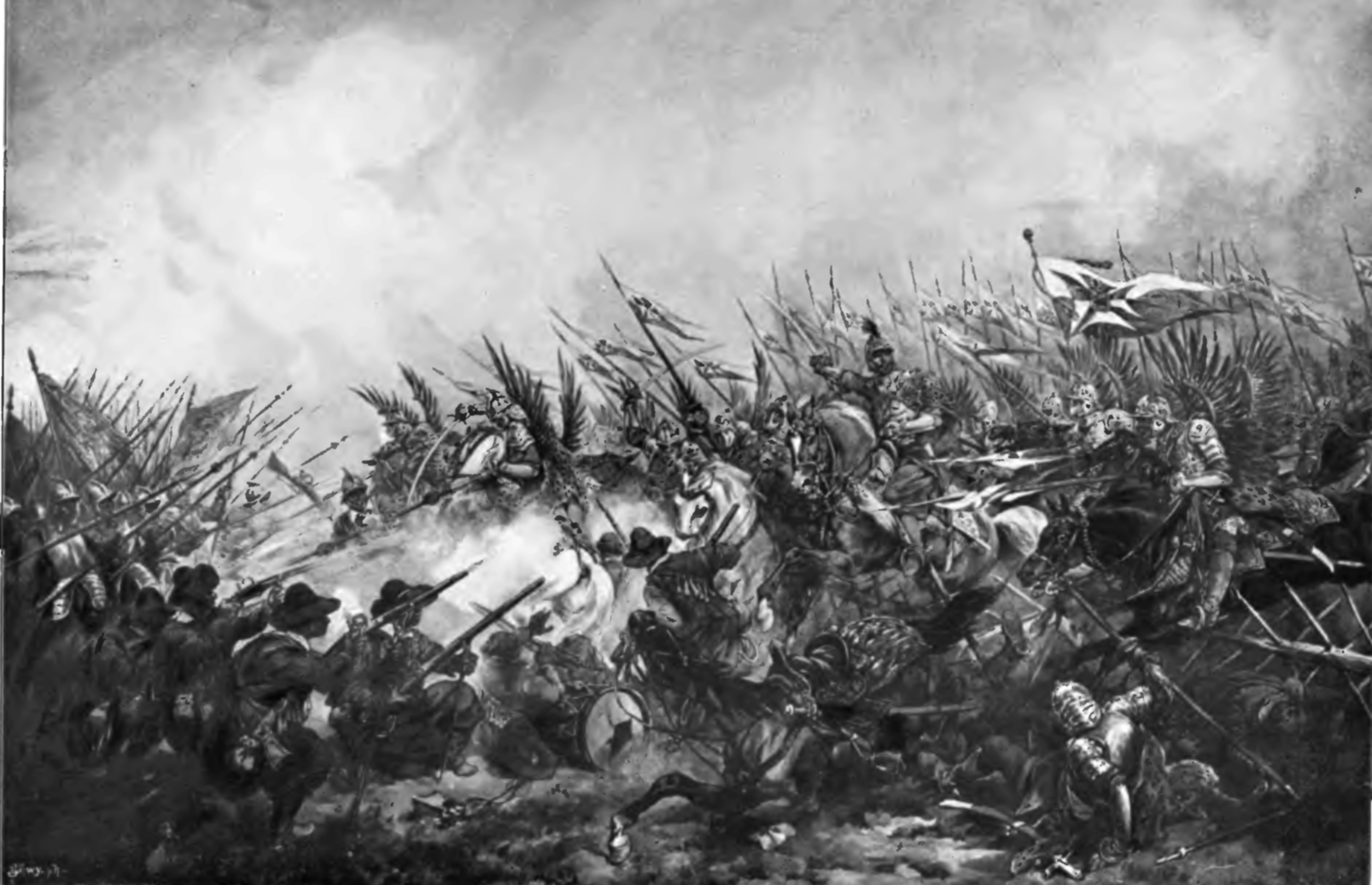
The image is a painting of the Battle of Kircholm, fought on September 27, 1605 between the Polish-Lithuanian and the Swedes. This battle is famous for the decisive cavalry charge because it broke with fundamental principles of military strategy. The painting depicts the loading of the Winged Hussars on the formation of pikemen Swedes. Using the tactic of "attack cross" the Winged Hussars charged in front and galloped against the wall of spades, which since ancient times been considered a suicide attack. But thanks to their excellent tactics, weaponry and discipline, the Winged Hussars were able to penetrate the formation of pikemen and delete it from the face of the Earth, an amazing achievement no doubt.


The above image you see here belongs to the Battle of Vienna, which took place on 11 rd of September 1683. Under the leadership of King Jan Sobieski III, 3.000 Winged Hussars charged at full gallop against some 200,000 Ottoman Turks who were besieging the army of the Holy Roman Empire in the city of Vienna. The charge was so powerful and devastating that the Ottoman army was brought to its store of supplies, as seen in the image, a moment later, the Ottomans fled. The Winged Hussars charge that made this day is considered one of the largest and most epic in history, began retreating to a force almost 70 times larger and saved Christian Europe from Muslim domination.

Finally, I want to share a rather famous recounts in detail the last thing thousands of Swedes, Cossacks and Turks were:

"While your army is in battle formation, scanning the enemy lines across the country. layered Riders crimson begin their advance towards you, slowly at first, keeping the strength of their horses for the last moments of the load. As the rough military gains speed, your own horse become agitated and a strange hissing roaring grows in the air pounding on the shoes. Your stomach shrinks and a cold sweat goes through you. Mounted on horses, 16 or 17 hands in height, rough riders seem even more impressive when you see giant wings of eagle feathers on their heads arching metal. On the disciplined ranks of powerful figures of iron, flapping huge banners showing pictures of a white eagle on a field of blood red and others showing the winged archangel, Michael. Fantastic coats and clothes of a wolf, tiger and leopard skins toss around each soldier as they continue their ominous attack. As you begin your counter-attack, knights galloping down their spears covered in gold leaf with banners flowing to the final impact. You promise yourself that if you survive this day, never forget your encounter with the Polish Winged Hussars "

Tuesday, March 23, 2010

Nightmare Before Christmas Boxers

The Winged Hussars "Chivalry Is Not Dead"

That phrase translates as "Chivalry is not dead." The other day browsing page one of my friends, I found this phrase in your profile - "Chivalry is not dead," and I wondered if I was actually understanding the real meaning of the sentence or just want to look good lady .

Unfortunately I discovered that I was using to woo women after they go and I could not help make the clarification. The meaning of the word "chivalry" is commonly misunderstood, and partly blame science fiction (Hollywood) and Disney, as absurd as it sounds true.

The "cavalry" or "Knight" does not open the door for a lady, give your coat when you are cold or standing entering or leaving each woman. All these actions are linked to the Cavalry, but represent another ideal, that of "courtly love."


The image depicts what really is the Cavalry. In the Middle Ages, the Knights not only have strength and hablidad required for combat, but also expected them to have a temperament for aggressive side countered with his gentlemanly side. It was not always so, the ideal of the virtuous gentleman born in the court of Eleanor of Aquitaine before it, the men were violent and selfish. This is because before the twelfth century AD, the Knights still were a privileged class but rather were considered peasant warriors who contributed to the task of helping the needy but it drew little advantage to the process.

was not until the late twelfth century aD those old destructive practices began a gradual transition towards a more civilized and honorable. Etienne de Fougeres, the then Bishop of Lisieus, believed that the nobility was the only class that could be part of the specialized system of Cavalry and a special kind of warriors would be necessary to carry out new ideals. In 1241 AD, Henry III of England gave strength to the cause of the bishop and declared that any English who possess a certain amount of property, would be classified as a Knight.

Thus was born the Code of Chivalry, which is worth mentioning that it was truly a code to follow but rather was a moral system that went beyond the rules of engagement and introduced the concept of gentlemanly behavior, some qualities idealized by the Knights were the courage, courtesy, honor, and later, gallantry before women.

Here I present a list of chivalry, as I mentioned before, moral precepts are simply so there is no definite list but these are the best I could find:

  • believe all the teachings of the Church and observe all instructions.
  • defend the Church.
  • fear God and keep His Church.
  • will respect all weaknesses and shalt constitute thyself yourself as an advocate for them.
  • Love the land they were born.
  • not recoil before thine enemy.
  • thou shalt unceasingly war without mercy against the Infidel.
  • perform scrupulously thy feudal duties, if not inconsistent God's laws.
  • never lies and will remain true to your word.
  • 'll be generous and give generously to all.
  • You are always and everywhere the champion of good and right against wrong and injustice.
  • live to serve the King and your land.
  • live to defend the Crown, the land and everything to keep him affection.
  • serve your Lord with courage and faith.
  • will live your life in such a way that is worthy of respect and honor.
  • will live for freedom, justice and all that is good.
  • never attack an unarmed enemy. Never will you use your
  • weapon against an opponent not equal to you.
  • never attack from behind.
  • succor the widows and orphans. I will refrain from
  • harm or offense.
  • will live with honor and glory.
  • will reject monetary rewards.
  • avoid lying to your neighbor.
  • prevent cheating.
  • prevent torture.
  • Porel will fight good.
  • 'll keep the honor of your fellow Knights.
  • prevent injustice, meanness and deceit.
  • keep your faith.
  • speak the truth at all times.
  • persevere to the end in every company you started.
  • never reject the challenge of an equal.
  • 'll Never back the enemy.
  • will obey the law of the king, your land and the Cavalry.
  • administer justice.
  • will protect the innocent.
  • will exhibit self-control.
  • Show respect to authority.
  • respect women.
  • Exhibit courage in your words and your actions.
  • will defend the weak and innocent.
  • destroy the evil in all its monstrous forms.
  • crush the monsters that steal land and people.
  • will fight with honor.
  • avenge the exploited.
  • Never abandon a friend, ally or a noble cause.
  • will fight for the ideals of king, your land and the Cavalry.
  • will die with courage.
  • keep your word of honor.
  • will keep your principles.
  • Never betray a confidence or comrade.
  • prevention of deceptive practices.
  • Respect life and freedom.
  • 'll die with honor.
  • Exhibit manners.
  • 'll be polite and attentive.
  • will respect the hosts, women and honor.
  • be loyal to your king, your land, freedom, honor and chivalry.
  • be loyal to your friends and all who put trust in you.
Finally, the virtues of the Knights of Chivalry were described in the fourteenth century by the Duke of Burgundy. The words used to describe the virtues of the Knights are

  • Fe Caridad
  • Sagacity
  • Justice Prudence
  • Temperament True Resolution
  • Freedom Hope
  • diligence
  • value
As we can see, the only mention made of women in the list, said they are owed respect, but no more. That's why using the word "chivalry" to denote the gallant treatment towards women is wrong. A better word would be "gallant" or "courtesy" and here's why.

As I mentioned before, the romance and courtly love are closely related to the Cavalry and these ideals were widely used during the Middle Ages. There were strict rules for courtly love and even came to be considered an art that was practiced initially by members of the European court in the Middle Ages, but later spread to all social classes in a very curious that I will tell you later.

Courtly love was the great ideal of the Middle Ages as the Knights allowed the ladies to show their mutual admiration, regardless of marital status. It was very common that a lady gave him a garment or personal item a Knight to take him with them to war or slides for a major tournament and that is how the two sides closer relationship.


The origins of courtly love are very varied and is a bit difficult initially clear but it is generally believed that began in Aquitaine, France in the twelfth century AD The ideal spread to Europe and was practiced in England since the fourteenth century to the sixteenth century. During this period, marriages were still arranged and had little to do with love. A successful marriage was the one to bring benefits and material gain for the participants and their families.

So how is it appears the ideal of courtly love, the answer is in the war. The Middle Ages is particularly famous for its context of war between Europeans and Europeans against Arabs and Muslims. During this period, the vast majority of men went to war to distant places and when regresaban a casa, traían consigo nuevas ideas y costumbres que habían aprendido en sus viajes. Durante la Edad Media, los soldados que entraban en contacto con la cultura Árabe y Persa, se influenciaban por su idea espiritual de un amor deseado, la cuál llevaban de regreso a Europa y la daban a conocer. La gente aceptaba esta idea pues era bastante atractiva y es así como nace el amor cortés.

Una característica importante del amor cortés es que se consideraba inconsumable, es decir, que el amor que dos personas se pudieran tener, nunca iba a poder ser por diversos factores. Los trovadores de la Edad Media hacían un gran trabajo cantando canciones de amores incosumables por toda Europa, y es así como el ideal expanded. We could consider this as the beginning of romance as we know it.

This new code of courtly love was a very strict, and the Knights and in general anyone who would take, should follow to the letter. Once again, here are the list of code as I managed to collect:

  • avoid greed like a plague and to take opposite.
  • 'll keep your chastity for the sake of those you love. Never
  • you strive consciously to break a right love in which someone else is already committed.
  • Never will you choose as a lover someone to your natural sense you would be ashamed to marry.
  • be fully aware of avoiding falsehoods.
  • should not have a lot to know your affair.
  • 'll be obedient to all things, and requests for the ladies.
  • You should strive to ally the service of love.
  • When you receive or give comfort, modesty should always keep in mind.
  • not speak evil.
  • not disclose affairs.
  • 'll be attentive and polite in all your stuff.
  • In the practice of the consolations of love, not to exceed the desires of your lover.
  • Marriage is not a real excuse para no amar.
  • Aquél que no es celoso no puede amar.
  • Nadie puede estar atado por un amor doble.
  • Es bien sabido que el amor siempre está creciendo o decreciendo.
  • No hay placer en aquello que un amante toma de su amada contra su voluntad.
  • Los muchachos no aman hasta que alcanzan la edad de la madurez.
  • Cuando un amante muere, una viudez de dos años es requierida por el sobreviviente.
  • Nadie debe ser privado del amor sin la mejor de las razones.
  • Nadie que no esté propulsado por las persuasiones del amor, no puede amar.
  • El amor es siempre un extraño en la casa de la avaricia.
  • Es impropio amar a una mujer with you ashamed to seek marriage.
  • A true lover does not want to accept any other than the love of his beloved.
  • When you age, love rarely lasts.
  • The achievement makes it easy love of little value, the difficult achievement of love makes it valuable.
  • A lover regularly turns pale in the presence of his beloved.
  • When a lover sees his beloved, his heart begins to pound.
  • A new love puts an old one in flight.
  • Good character alone makes any man worthy of love.
  • If love diminishes, it falls very quickly and rarely revives.
  • A man in love is always apprehensive. True jealousy
  • increase the feeling of love.
  • Jealousy incremented when one suspects his lover.
  • He whom love vexes eats and sleeps very little.
  • Any act of a lover ends with the thought of his beloved.
  • A true lover does not see anything good except that which pleases his beloved.
  • Love may not deny nothing to love.
  • A lover can never have enough consolation to his beloved.
  • The minimum presumed cause the suspect to his beloved mistress.
  • A man who is vexed by passionately loves not really use it.
  • A true lover is constantly and continuously possessed by the thought of his beloved.
  • Nothing prohibits a woman from being loved by two men or one man by two women.
see, courtly love was something quite serious and that was even higher ideal of a religion. He was considered the source and origin of all things good and even promoted love among different social classes. As I mentioned before, this expansion to all social classes was very curious because it violated the precepts of the Church but at the same time it was considered appropriate.

Say there was a woman, the daughter of a merchant and was devoted to the Church and chastity, this woman would worthy of the love of a noble knight. However, as I mentioned before, the "love" in arranged marriages of the Middle Ages was rather a duty than a gift to those who truly were in love. Therefore, one could say that the courtly love favored the notion that adultery was to be admired, which seems to go against the teaching of loyalty to the Church.

The reasoning is very simple, first marriage was forced and arranged and of course there was true love between the couple. On the other hand, promoted courtly love true love between a man and a woman. Then, a married Caballero truly fall in love some other woman, would apparently committing adultery, but ironically, that adultery is wrong because that marriage is not based on love, is not valid. Therefore, the "adultery" under the circumstances I have described, was right!

see, chivalry and the code of courtly love are closely related but still need to know to make the distinction. We can not speak of "Gentlemen" or "chivalry" today to refer to the gentle treatment of women because the context has completely changed and the term actually refers to the Medieval Knights in a war context. However, we still get medieval ideals waste value, courtesy, honor and gallantry before women and we should not reject them. Things have changed but it is perfectly correct to open the door for a woman, give your coat when it is cold and removed his hat before him: after all, everyone wants to be "Knights" is right and let us be.

Saturday, January 30, 2010

Black Stools Guinness

The Mayan Calendar Galileo Galilei

The Maya civilization is a culture that has not been given the credit it deserves in reality. With a calendar more accurate than ours, and mathematical skills (the use of 0 that even the Romans discovered) and astronomy, the Mayan culture is on par with such great civilizations like Egypt.


With the approach of 2012 and all the speculation that has been done about it, a number that wherever you look is going to be popping up, the number is a Maya date: 13.0.0.0. 0.

In this post, I'll talk just a little on the subject in 2012, but my goal for this post is rather to show how to convert dates of the Mayan calendar to the Gregorian calendar so they can understand why he has assigned the December 21, 2012 the date of the end of the world. " Before

should know some things. Our calendar we perceive in a linear fashion, ie, "infinite" because as they pass the years just add 1 to the account and apparently only move without an end. The Mayan calendar is a cyclical calendar, where every few minutes, the countdown to 0 and then restart the cycle.

why it's a bit difficult to make exact matches because of that difference must be added the fact that our Gregorian calendar has an error of about 4 years from the date you start counting the time. With this very much and we can begin.

time count of the Mayan calendar begins about 5000 years ago. Convert to Gregorian date, the day is the Aug. 13, 3113 BC The Maya calendar dates are expressed with 5 digits separated by dots. Each of these numbers has a name and a numerical equivalent. Here I present the list on which all:

Baktun - 20 katun - 144.000 days or about 400 years (394.52 of ours)

Katún - 20 Tunes - 7,200 days or about 20 years (19.73 for our )

Tun - 18 Uinales - 360 days or about 1 year (less than 5 of one of ours)

Uinal - 20 Kin - 20 days or 1 month

Maya Kin - 1 Day - 24,017 hours
These 5
names correspond to the 5 numbers in the Mayan dates from left to right respectively. You see, the whole system is an equivalence and they can turn any Maya date to Gregorian date. As I said, accuracy is limited to the years, calculate the months and days is much more complicated.

'll show 2 examples of conversions to clarify the use of this system. Let's first try with an important date, for example, 356 BC, the year in which Alexander the Great was born. Maya is the date 8.15.19.8.2.

First we take the first digit, the Baktun, ie "8" and multiply it by its equivalent in the Gregorian calendar which is 144.000.

8 x 144,000 = 1,152,000 days.

Now, we turn to the Katun and multiply it by its equivalent:

15 x 7.200 = 108.000 days. Tun

follows:

19 x 360 = 6.840 days.

The Uinal:

8 x 20 = 160 days. And finally

Kin:

2 x 1 = 2 days.

Now, take the five results and add:

1,152,000 + 108.000 + 6.840 + 160 + 2 = 1,267,002 days.

The next step is to convert the previous result to years. To do this, divide the number by 365.25 (the .25 comes from the extra 6 hours "left over" every year and every 4 years gives us an extra day: 24 hours / 6 hours per year = 4 years = 1 / 4 = .25):

1,267,002 / 365.25 = 3468.86

For example issues, I will round the number to 3469. And there is, the last thing left to do is take the initial date of the Mayan calendar, ie 3113 BC and subtract the years we have just calculated. If we wish to calculate the date is before Christ, it must make a subtraction. If the date is AD, do the "3113" negative and add up the years to calculate.

3113 - 3469 = -356

And there you have it, a precise calculation of years between Mayan and Gregorian dates.

Finally, we calculate the famous 13.0.0.0.0. The steps are the same as in the example above, the only thing that changes is the numbers:

Baktun - 13 x 144,000 = 1,872,000

Katún - 0 X 7.200 = 0

Tun - 0 X 360 = 0

Uinal - 0 x 20 = 0

Kin - 0 x 1 = 0

The sum is obviously = 1,872,000 .

Now we turn to years

1,872,000 / 365.25 = 5125.25.

the round to 5125. Finally we make the calculation with the original Maya. AD to be a date, do the "3113" negative and add years to calculate:

-3113 + 5125 = 2012

Once again it is a perfect and precise calculation as regards the years.

The latter calculation is just to show the basis for whole theory about 2012 because as I mentioned, the Mayan calendar is cyclical and based on these calculations, in 2012 completes a cycle (12) and begins a new (13). So, speaking of the "end times" type Armageddon or Apocalypse is vague in regard to the Maya, as more than a destruction and annihilation of the world, the "end times" I would describe more as the "end of a cycle "refers rather to a change in humanity that is being repeated (as in every cycle), together with natural phenomena that we are living.

The Mayans made no mistake when measuring the cycle time as the experts suggest we learn from the Maya so that history does not repeat. The Maya lived in the ecological edge since indiscriminately exploited their environment and had a huge population base, as we do today. All that remained for the entire system disappeared, it was a sudden imbalance, as was the colonial invasion. Now, any war breaks out, along with time and circumstances in which we live, it could be a dangerous combination that could lead to a rapid decline and the collapse of civilization.

Although the date 2012 is etched sharply in the ancient stone, most modern scholars suggest that the Maya left us a warning and not a prophecy. And it's true or not, I suggest you listen.

Sunday, January 10, 2010

Gay Hookup Spots In Columbus Ohio


To mark the 400 years since the discovery of the telescope and the conclusion of the International Year of Astronomy (2009), I decided to dedicate a post to the famous scientist Galileo Galilei, not to review his life and works but to clarify the distorted story today about their work and the controversy with the Catholic Church.


Galileo Galilei, one of the most famous astronomers and scientists of his time (seventeenth century) and modern history, was a man whose discoveries moved beliefs traditional and unintentionally, "contradicted" the Catholic doctrine, which has led to today erroneously he is classified as an enemy of the Church and used his name to criticize the Church of the enemy of progress. Let's clarify some facts.

Galileo supported the heliocentric theory proposed earlier by Copernicus. In his "Dialogue Concerning the Two Chief World Systems, Galileo expounded this theory. This book opened a lot of controversy and in 1616 the Roman Inquisition accused Galileo to support the heliocentric theory because it seemed to go against what the biblical tradition said.

is where we have to stop a little. Was the Bible or its interpretation, the basis for a scientific postulate, the answer is no. Galileo knew this and shield in this argument when faced trial. Galileo defended the idea that heliocentrism was not contrary to the Holy Bible and explained that the Scriptures were not intended to teach science, but that suited the knowledge of all times, even, as demonstrated in the tradition of the Church were arguments that gave reason to its principles.

So why you think the heliocentric theory of Copernicus and Galileo defended as absurd and contrary to tradition?, To answer this question we must refer to the Bible. Passages in Psalm 93:1, Psalm 96:10 and I Chronicles 16:30, we read the following: "firm is the world without hesitate." Psalm 104:5 says practically the same and finally in the Book of Ecclesiastes 1:5 reads: "The sun rises and sun sets and tends toward the spot where it goes."

Based on these passages, the Church, under a literal interpretation, stated that the Earth was the center of the universe, he was not moving and the sun and planets revolved around it, ie geocentric. In an era where the Church was particularly sensitive to those who interpreted the Bible on their own, Galileo was subject to two trials, the first in 1616, which was not an actual trial, but rather a warning to recant his heliocentric idea. 17 years later, in 1633 a second trial, this time, all the way, ended with the sentence of Galileo to prison to keep their ideas.


As I mentioned before, the reading and interpretation of the Bible should not be done literally, this is a clear example of why. In his time his works were banned and placed on the Index Librorum Prohibitorum until 1741, before the optical test the orbit of the Earth, Pope Benedict XIV made the Holy Office would give the printer the first edition of the works complete Galileo. In 1757, construction was authorized in favor of the heliocentric again and removed from the Index Librorum Prohibitorum . Even Pope John Paul II apologized for the mistakes that have been committed by men of the Church throughout history.

Galileo, as a faithful believer, I accept your decision and even gave thanks to 3 of the 10 judges voted for acquittal. Because of its goodwill, the sentence was commuted to house arrest, so never set foot in jail. Galileo spent his last days at his villa in Florence, where he remained blind, sick and where he died at age 78. These distortions they say, was tortured and burned under alive at the stake are totally false.

Galileo died not at odds with the Church, was never even considered a heretic. At the end of his life the same state: "In all my works, none can find the slightest shadow of something that contradicts the piety and reverence towards the Holy Church." His daughter became a nun herself and she was the one who picked up his last word: "Jesus."

In conclusion, the case of Galileo is one that shows how science and religion should not be fought alone should give themselves space. Has been said that the case of Galileo opened "Pandora's box" to start "war" between science and religion. Many legends and facts have been derived from the time of Galileo, including the famous Illuminati which surely have heard. The reality is that Galileo is a pillar of science and at the same time a test of faith, obedience and acceptance of their religion, why has the respect of both communities and now rests in the Basilica of Santa Cruz in 1737 where he built a monument in his honor.