While saying that war is horrible and that any pest or slag is preferable to it, I say that the mere image of a Winged Hussar charging is one of the few exceptions that may cause war is very beautiful. Please believe me, see it yourself in one of the magnificent works of Mariusz Kozik:

The Winged Hussars of Poland are without a doubt my favorite military units. Their clothing is simply a work of art that becomes irresistible when mixed with the magnificence of a battle. And that is the story of the Winged Hussars is a story full of great battles, victories and charges heroic epic. Sounds like science fiction story, but in reality Husari, as they are known, always fought to the moment of truth.
By definition, a Hussar is a light cavalry unit that originated in Hungary around the fifteenth century AD Many authors believe that the Hussars originated from Serb warrior bands that crossed into Hungary after Turkish invasion on Serbia. However, by mid-sixteenth century in Poland, the Hussars were transformed into heavy cavalry and became the elite of the entire Polish-Lithuanian army as well as Europe. The Winged Hussars
were heavily armed. Its armament consisted of a spear called kopia , which was hollow to reduce weight and be more manageable. It was made of wood, wrought iron tip and had a length of between 4.5 and 6.15 meters long. Beneath her left leg, the Winged Hussars wore a sword thrust called koncerz , this sword was about 1.6 meters long and was used as a spear to penetrate the armor, not to cut, in fact, even had the edge on the sheet, only a very sharp tip to serve your purpose. On the left side carried their famous swords, known as szabla husarska , who were their weapons of combat. Like many elite units in history, as the Companions of Alexander, the Winged Hussars arrived to use their weapons of choice by individuals, as well as axes, hammers and various types of decks. Added to their weapons, Husari also carried one or two guns or rifles that fired a short distance before loading with the aim of disrupting the enemy front lines and more devastating charge.
His armor consisted of a home town called szyszak Turco, who had a mask over the nose and mouth in the form of sheet. This gave the Hussars an even more daunting, because all you could see were his eyes fixed on the selected target. As head protection, had a metal shell to protect it's chest and neck, likewise, had shoulder pads and protection for at-arms. Used armor for the knees, and placed under her thighs padded coats of mail to give them comfort. Despite being highly protected, armor was fairly light, as a whole, full armor weighed around 15 kg., which allowed the riders reach speeds high enough and make more effective the load. As an exotic touch, the Winged Hussars used to wear a leopard skin attached to the body over his left shoulder as a layer. The objective of this piece was to terrorize and confuse enemy horses, because they are afraid of those wild animals which are not used and capture the presence of leopard skin because its smell is almost as good as dogs.
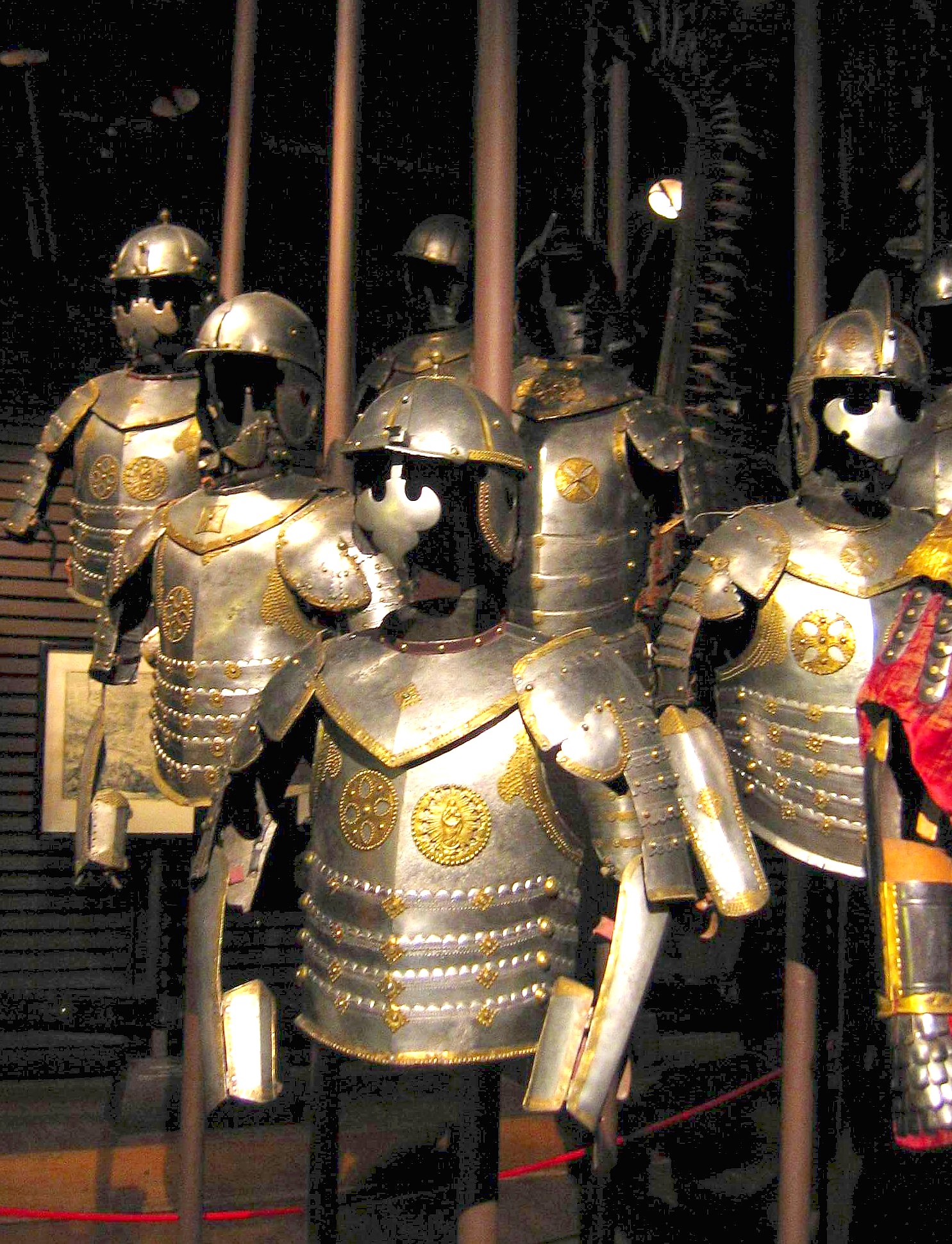
Finally, we have the jewel in the crown: the wings. The Winged Hussars were so named because of the practice of using a pair of magnificent wings that gave them a terrifying, not only made them appear much larger than they actually were, but it also gave them the appearance of fierce birds and eagles behind prey. Initially, the wings were placed on the sides of the riders but later were moved to their backs. The wings were made over a wooden frame and the feathers were commonly eagle or ostrich.

The purpose and use of the wings has been extensively studied and is not yet clear, however, there are many theories about them. The first and oldest suggest a package that the wings were attached to counter the Tatar ties pitchers who would not easily tie a Winged Hussar. Another common theory suggests that the wings were attached as when riding at high speeds, they produce a sound very thin and sharp that horses terrorized the enemies, who were not accustomed or trained to deal with it. In back, has also been suggested that the wings were attached to deafen themselves Polish horses in order to nullify the sounds they made with wooden instruments the Ottomans and Tatars.
However, some of these theories were apparently discarded in the 1970 during the filming of the movie "The Deluge" where several scenes that included charges of Winged Hussars found that the wings, while riding at high speeds, unbalanced rider to the point of almost throwing the saddle, likewise, when the wings were placed on the sides of the rider, slow considerably when it was galloping at high speeds. It is for these practices suggests that the wings were only used during ceremonies, parades and formal events and never for battle.
This conclusion is a bit difficult to digest because it sounds illogical that Winged Hussars have received that name and reputation just to go in his magnificent armor during ceremonies and important events. In addition, the vast majority of works of art, both literary and painting and music may represent the Husari holding their wings in battle. I doubt that all artists have agreed to over the centuries to represent wings if they were not really used in battle.

As battle tactics, the Winged Hussars came forward nearly two centuries to the world. The tactics used can be translated as "cross attack." The great Russian general Aleksandr V. Suvorov developed this tactic to his army and who is usually given credit for it, but as I mentioned before, the Polish and used 200 years earlier.
The "transversal attack" was developed as a result of necessity. During the time of boobies and gunpowder, the cavalry used to use the tactic known as "Caracollo" which was to ride toward the enemy, entering range shot, download guns or rifles and retire to reload. However, with the development of education and training combined with boobies Musketeers, "Caracollo" became useless as boobies while protecting the musketeers of the charges, they fired their rifles and decimated cavalry companies.
In response to this, the resourceful Poles developed the "transversal attack" which was to charge straight at full speed through the formations of musketeers and pikemen. To achieve this without being killed by the booby, the Winged Hussars were armed with long kopia , that throws that allowed them to hit the booby before he reached the rider or his horse. As a result of impact, the boobies were often thrown into the air on the rear of the training ranges, which increased the panic disorder and the load was more devastating.
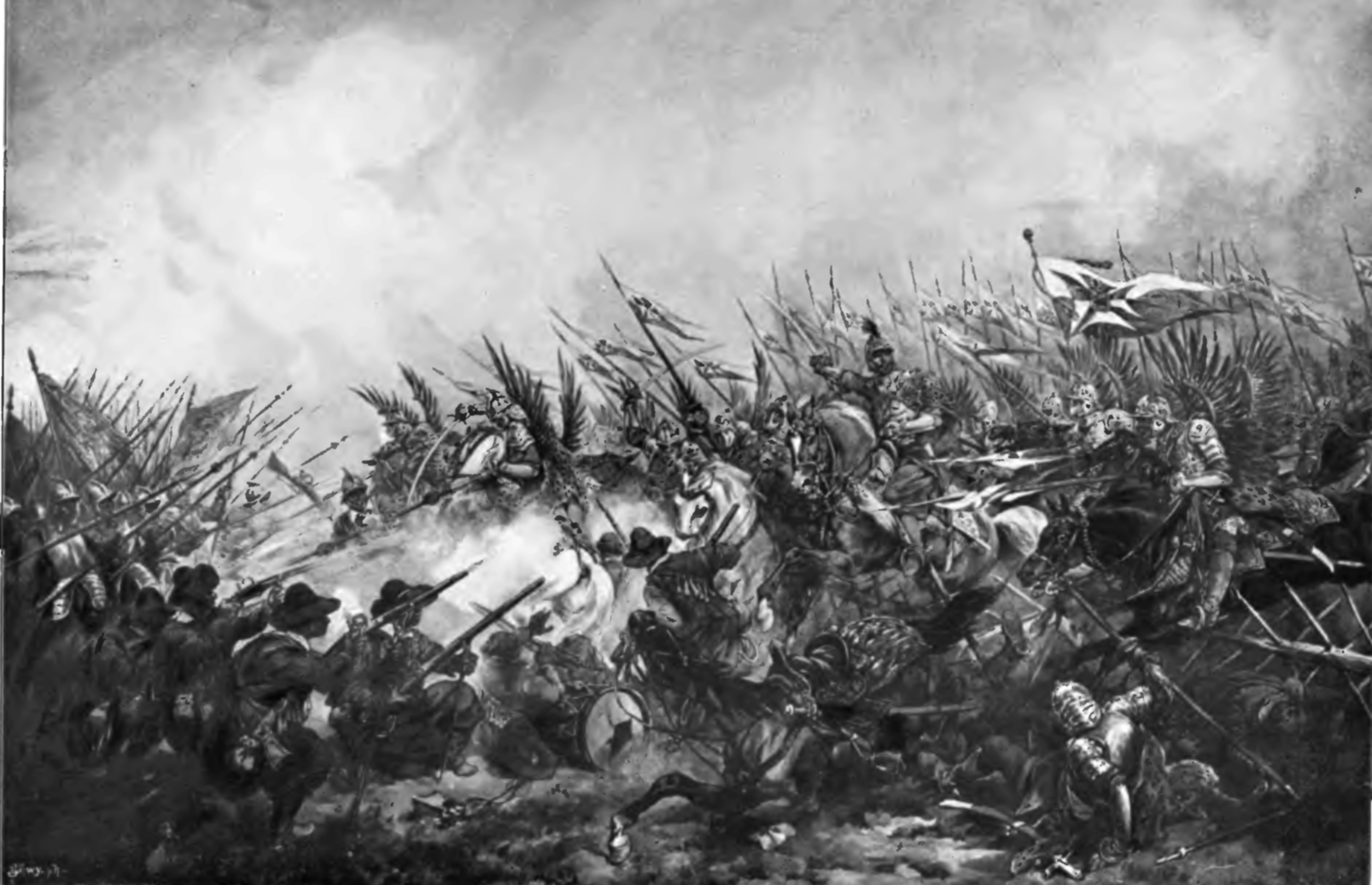
The image is a painting of the Battle of Kircholm, fought on September 27, 1605 between the Polish-Lithuanian and the Swedes. This battle is famous for the decisive cavalry charge because it broke with fundamental principles of military strategy. The painting depicts the loading of the Winged Hussars on the formation of pikemen Swedes. Using the tactic of "attack cross" the Winged Hussars charged in front and galloped against the wall of spades, which since ancient times been considered a suicide attack. But thanks to their excellent tactics, weaponry and discipline, the Winged Hussars were able to penetrate the formation of pikemen and delete it from the face of the Earth, an amazing achievement no doubt.

The above image you see here belongs to the Battle of Vienna, which took place on 11 rd of September 1683. Under the leadership of King Jan Sobieski III, 3.000 Winged Hussars charged at full gallop against some 200,000 Ottoman Turks who were besieging the army of the Holy Roman Empire in the city of Vienna. The charge was so powerful and devastating that the Ottoman army was brought to its store of supplies, as seen in the image, a moment later, the Ottomans fled. The Winged Hussars charge that made this day is considered one of the largest and most epic in history, began retreating to a force almost 70 times larger and saved Christian Europe from Muslim domination.
Finally, I want to share a rather famous recounts in detail the last thing thousands of Swedes, Cossacks and Turks were:
"While your army is in battle formation, scanning the enemy lines across the country. layered Riders crimson begin their advance towards you, slowly at first, keeping the strength of their horses for the last moments of the load. As the rough military gains speed, your own horse become agitated and a strange hissing roaring grows in the air pounding on the shoes. Your stomach shrinks and a cold sweat goes through you. Mounted on horses, 16 or 17 hands in height, rough riders seem even more impressive when you see giant wings of eagle feathers on their heads arching metal. On the disciplined ranks of powerful figures of iron, flapping huge banners showing pictures of a white eagle on a field of blood red and others showing the winged archangel, Michael. Fantastic coats and clothes of a wolf, tiger and leopard skins toss around each soldier as they continue their ominous attack. As you begin your counter-attack, knights galloping down their spears covered in gold leaf with banners flowing to the final impact. You promise yourself that if you survive this day, never forget your encounter with the Polish Winged Hussars "


